
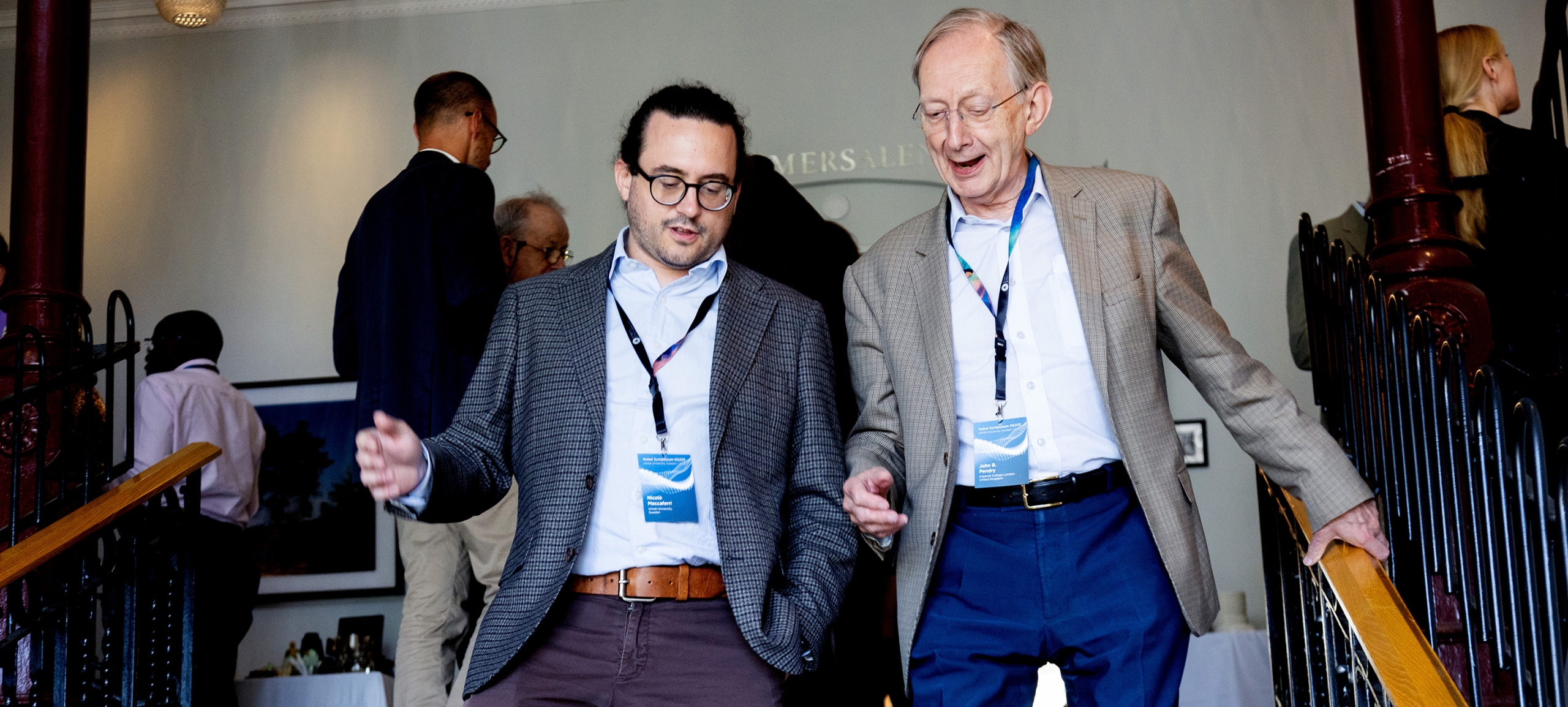
The Nobel Symposium brought some of the world’s leading physicists to Umeå. Scientific meetings foster new ideas through shared curiosity. Photo: Abebe Asres, Västerbottenskuriren (VK).
At the turn from June to July, Umeå became a meeting place for some of the world’s leading researchers in metamaterials and nanophotonics. For three intense days, I had the privilege of chairing the Nobel Symposium ‘Metamaterials science and technology: structuring light and sound in space and time’, hosted by Umeå University and supported by The Royal Swedish Academy of Sciences and the Knut and Alice Wallenberg Foundation. It was a remarkable experience: scientifically demanding, personally energising, and full of conversations that seemed to spark new ideas in real time.
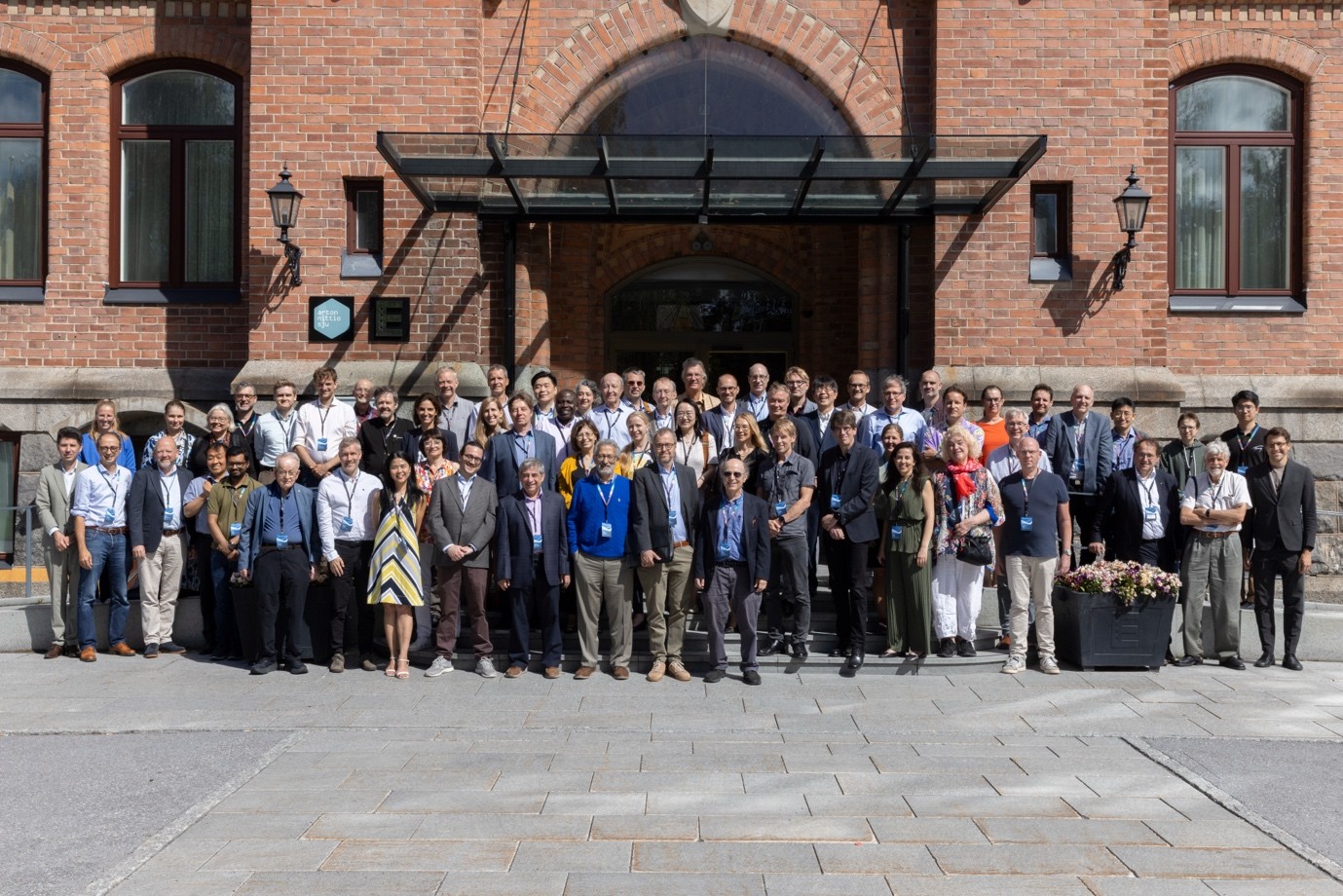
Participants from the Nobel Committee of Physics and the Royal Swedish Academy of Sciences (Physics Class) and speakers from all around the world gathered in Umeå for the Nobel Symposium on metamaterials science and technology. Photo: Malin Grönborg
Metamaterials are sometimes described as “materials beyond materials”. Instead of relying only on what nature gives us, we design tiny structures – often smaller than the wavelength of light or sound – to make waves behave in completely new ways. This can lead to effects such as unusual refraction. In turn, this can enable invisibility cloaks, advanced sensing, compact optical components, better imaging and new quantum technologies. Similar ideas can also be used to guide sound and vibrations, potentially helping to protect against earthquakes or tsunamis. In simple terms, metamaterials allow us to ask: what if we could design not only a material, but the rules by which waves move through it?
This “meta way of thinking” was the deeper reason why I wanted to bring this symposium to Umeå. The field has grown from a handful of bold theoretical ideas into a broad research area that brings together physics, engineering, materials science and many other disciplines. The Nobel Symposium format offered a rare opportunity to gather pioneers who shaped the field together with newer voices pushing it in unexpected new directions. The goal was not only to present results, but to create a space where people could step outside their everyday specialisations and think together about where the field is heading.
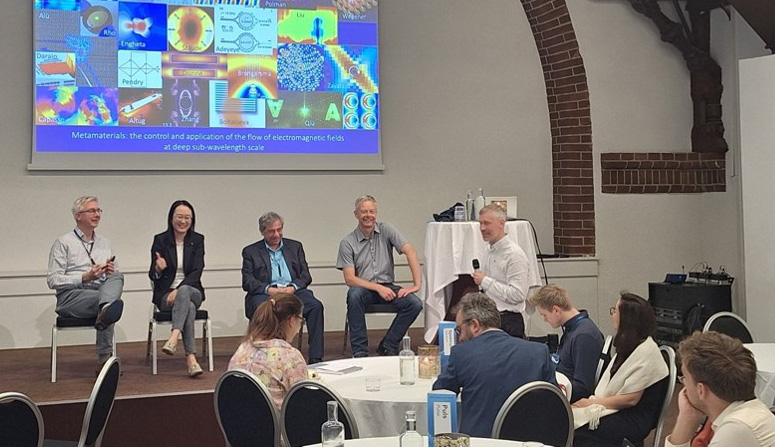
One of the panel discussions with the speakers of the session “metamaterials technologies”, from left to right: Albert Polman (AMOLF, The Netherlands), Laura Na Liu (University of Stuttgart, Germany), George Eleftheriades (University of Toronto, Canada) and Mark L. Brongersma (Stanford University, USA). Photo: Philippe Lalanne
The atmosphere was focused, but discussions often moved far beyond individual specialities. Topics ranged from the history of metamaterials to quantum technologies, advanced sensing and emerging applications. We also discussed how structure, geometry, symmetry and time can become design tools, much like chemical composition has traditionally been.
For me, one of the most memorable aspects was seeing how naturally conversations continued during coffee breaks, lunches, the city tour, and evening gatherings. Science often advances through formal talks, but it also advances through informal exchanges – someone asking a new question at exactly the right moment.
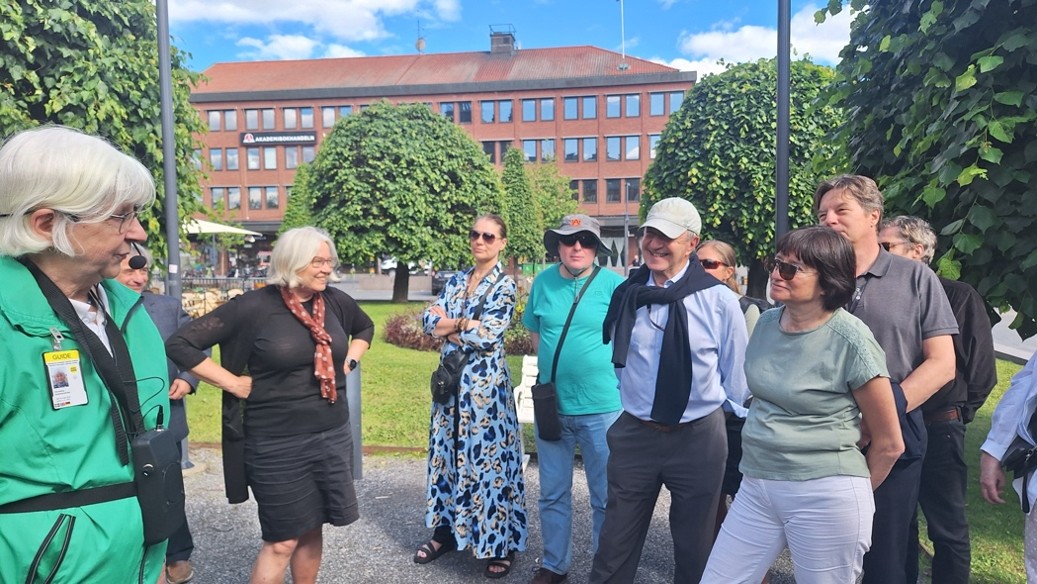
Scientific discussions continued beyond the lecture hall, creating space for informal exchanges and new collaborations. Here a moment during the city tour and our little adventure at Curiosum Science Centre. Photo: Philippe Lalanne
Arranging such an event is a large project. It requires scientific vision, trust from colleagues, practical coordination, and the support of many people across the university. But it is worth it. When Umeå University hosts an event of this kind, it does more than bring excellent scientists to northern Sweden. It shows that world-class research does not need to be concentrated only in the largest global centres. It can flourish where there is intellectual ambition, openness, strong local support and a collaborative culture.
The Nobel Symposium was followed by METAmeet, an international workshop on metamaterials and nanophotonics that opened the conversation to students, early-career researchers and a broader scientific community. This combination felt especially meaningful.
Looking back, what stays with me most is the feeling of shared curiosity. For a week, researchers from different disciplines, generations and continents shared ideas, meals and conversations in Umeå. That was exactly what I had hoped for. Bringing people together does not automatically lead to new ideas, but sometimes a conversation starts that would never have happened otherwise. Those moments make all the hard work worthwhile.
/Nicolò Maccaferri, UCMR Principal Investigator
